

Corporate policies are no longer just formal internal documents. Today, they serve as a key tool for assessing a business’s reliability by donors, tender organisers, and international partners. This topic was discussed by Anastasiia Skok, Head of ESG at BDO in Ukraine, on Ukrainian radio.
From 2028, the ESRS standard will become mandatory for most companies in the European Union. Ukrainian companies that work with European partners or plan to enter international markets should start preparing for the new requirements. This includes reviewing existing documents, creating a “policy tree,” and automating the monitoring of policy compliance.
Policies — the language of the international market
Corporate policies are a standardised set of internal company rules widely used in international practice. Through these policies, donors and clients assess a business’s ability to operate transparently, manage risks, and meet its obligations.The policies cover three key areas:
- Governance: anti-corruption, risk management, conflict of interest, and related topics
- Social: equality, occupational health and safety, human rights, etc.
- Environmental: environmental impact, carbon footprint, emissions and waste, and related aspects.
“The absence of such documentation, or its purely formal nature, already leads to lost opportunities to participate in tenders and international donor programmes. At present, donors and tender organisers operate in the language of policy. If a company does not have the necessary set of documents, it is simply not allowed to participate,” emphasises Anastasiia.
From documentation to implementation and oversight
In today’s global business environment, having corporate policies in place is no longer sufficient. Donors, financial institutions, and tender organisers increasingly assess not the mere existence of a policy, but its actual effectiveness — namely, how it is implemented, monitored, and how it influences a company’s activities.It is vital that corporate policies be integrated into the company’s strategy, internal processes, and management decision-making systems. It is this link between policy, strategic objectives, and day-to-day operations that enables a business to move from mere formal compliance to genuine risk management.
A key element in this process is monitoring the implementation of policies. International partners expect companies to be able to:
- identify responsible persons or departments
- establish measurable indicators (KPIs)
- record performance and any deviations
- explain the reasons for non-performance and the corrective measures taken.
Automated data collection is particularly important, especially in environmental and social areas. Policies that cannot be tracked or verified with data gradually lose trust of external stakeholders.
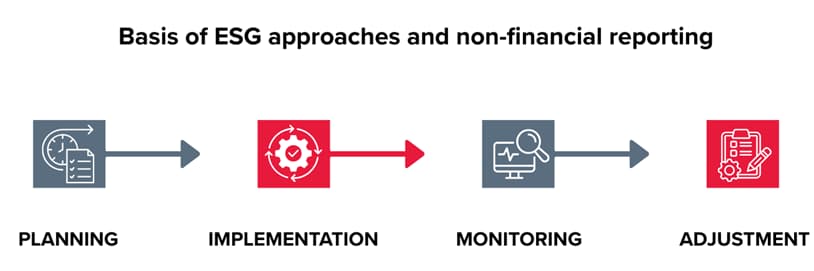
It is vital that policies be regarded as a living tool rather than a static document. If they demonstrate insufficient effectiveness over time, international practice provides for their review, update, or replacement. This cycle — “planning → implementation → monitoring → adjustment” — forms the basis of ESG approaches and non-financial reporting.
As part of an international network, BDO in Ukraine actively implements ESG approaches in its own operations, as reflected in its 2024 ESG Report.
European standards and time factor
The key regulatory benchmark is the European Sustainability Reporting Standards (ESRS), which implement the requirements of the CSRD Directive. These standards require not only the preparation of a report, but also the existence of a comprehensive internal infrastructure within the company, such as corporate policies, procedures, data collection systems, and internal controls.Even considering delays and transitional provisions, preparing for ESRS compliance requires at least one to two years. This involves:
- nventory of existing internal documents
- Development or updating of corporate policies
- Construction of a “policy tree” for governance, social, and environmental areas
- Definition of indicators, data sources, and responsible persons
- Testing of the information collection and analysis system.
Anastasia emphasises that European experience shows that companies delaying preparation often face a severe shortage of time and resources at the final stage. Attempting to prepare in a rush can overload financial departments, lead to errors in data, and increase regulatory and reputational risks.
How BDO in Ukraine can assist
BDO in Ukraine supports companies in transitioning from formal documentation to a functional ESG infrastructure. We offer the following services:- Assessment of existing corporate policies
- Development of a policy tree in line with ESRS requirements and donor expectations
- Support with the integration of policies into corporate strategy and operational processes
- Design of a monitoring system and support in preparing for ESG and non-financial reporting.
For Ukrainian businesses, the time factor needs to be considered differently. Companies that are part of European supply chains or cooperate with international financial institutions are, in practice, already subject to these requirements — even before they become formally mandatory in Ukraine. European partners are already requesting policies, data, and evidence of compliance.
The link to the full broadcast featuring the expert of BDO in Ukraine.
In the context of the implementation of ESRS standards and increasingly stringent requirements for business transparency, companies have limited time for systematic preparation — from reviewing existing documents to building an effective system for monitoring and managing ESG indicators. Those who initiate this process early will gain a competitive advantage, while those who delay risk losing access to financing, tenders, and European markets.
BDO in Ukraine supports companies in assessing their readiness for ESRS requirements, developing a portfolio of corporate policies, and establishing a practical ESG infrastructure. If you would like to discuss how our team of experts can support you in preparing for the future, please do not hesitate to contact us.
Next steps to take
Arrange an initial assessment of your corporate policies with the team of BDO in Ukraine. Based on the results of this analysis, you will gain a clear understanding of the following:
- Which policies are missing
- Which documents require updating
- How to build a policy tree without overloading your team
- How much time is required to prepare for ESRS requirements.
The earlier a business begins this process, the more strategic opportunities it retains and the fewer risks it faces.
Subscribe to BDO in Ukraine Newsletters
Subscribe