BDO Digital assists companies in the streamlining and automation of key business processes in practice. Our approach integrates CRM + automation + Microsoft + AI, to deliver swift results, including process transparency, control, analytics and a substantial reduction in manual work.
As a Microsoft Gold Partner, BDO leverages the
Microsoft ecosystem to create scalable, secure and user-friendly business solutions.

What we do
We implement solutions that combine CRM + automation + Microsoft + AI, focusing on real business needs:
- CRM systems for managing sales, marketing and customer relationships
- Simple and mid-level business process automation without ERP implementation
- Dashboards and management analytics for executives
- Solutions based on Microsoft low-code / no-code platforms
- Integrations between CRM, finance, document management, email and other systems
- AI tools to improve process efficiency and support management decisions
Business Process Automation Architecture
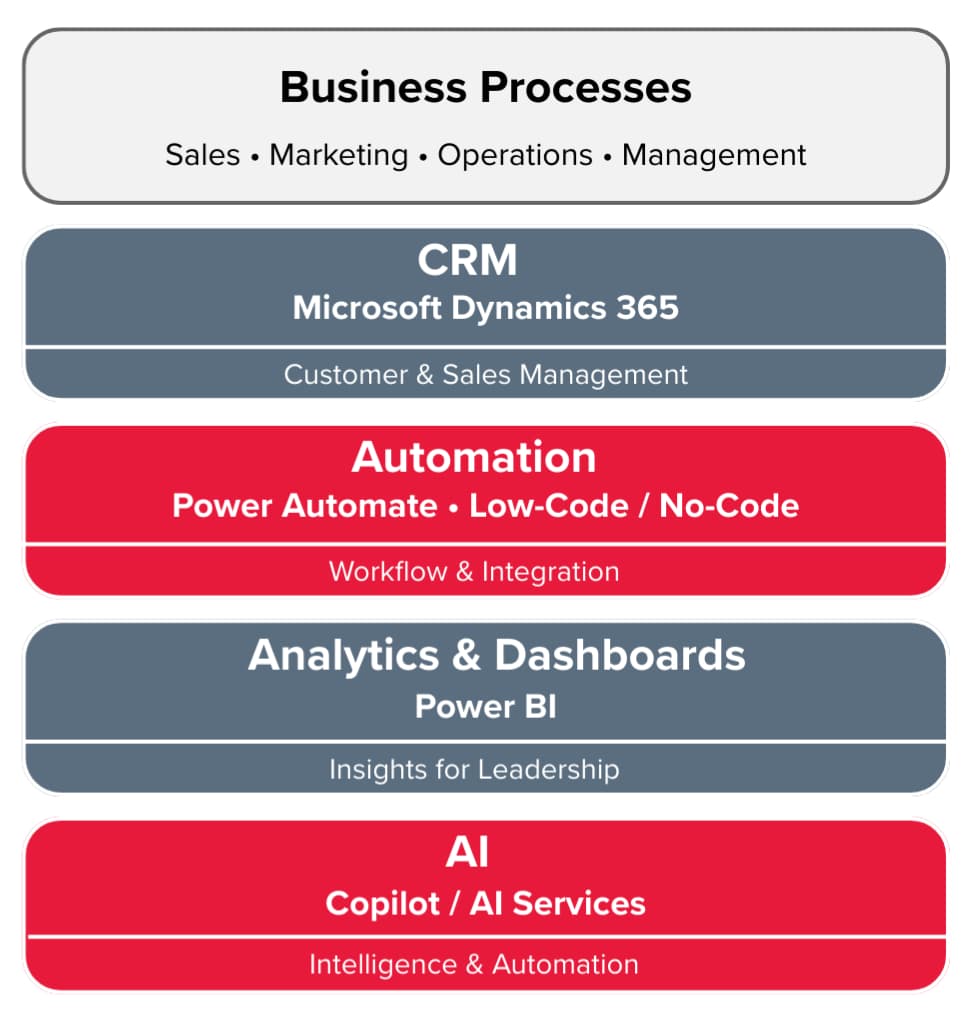
Architecture diagram of business process automation demonstrating the interaction of Microsoft Dynamics 365 CRM, Power Automate, Power BI and AI Copilot to support sales, marketing, operations and management.
This architecture shows how the Microsoft ecosystem enables end-to-end business process automation — from customer engagement to analytics and the use of Artificial Intelligence for management decisions.
Our focus is applied automation and CRM, which are both quick to launch and easy to scale.
Our priority is not heavy, multi-year transformations but applied automation that:
- launches quickly
- adapts easily to change
- does not overload the organisation with complex architecture
This approach enables businesses to see results at the early stages of automation.
Our approach
We don’t automate chaos. Every project begins with the analysis and optimisation of business processes, followed by the implementation of digital solutions based on CRM + automation + Microsoft + AI. This approach prevents technology from merely recording an inefficient model instead of improving it.
First, we analyse the current state of business processes to identify bottlenecks and duplication, as well as those with the greatest automation potential. Next, these processes are formalised into as-is / to-be models, creating a transparent foundation for change. Based on this, we then develop an optimisation plan with clear priorities, implementation stages and expected business outcomes.
Optimised processes are prepared for automation: logic is simplified, manual operations and error points are reduced. The final step is to select CRM, automation tools, Microsoft solutions and AI that are tailored to the company's industry, business scale and strategic goals, with built-in cybersecurity by design and data protection at every stage.
The Path of Business Process Optimisation and Automation
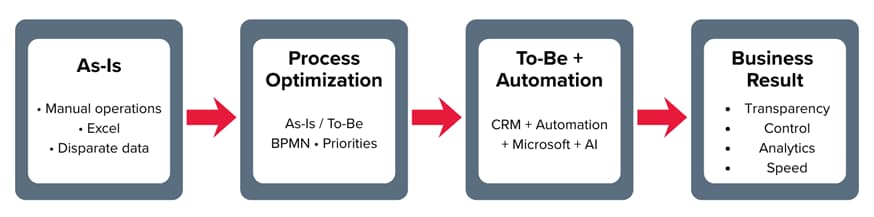
Step-by-step diagram showing the transition from manual operations and fragmented data (As-Is) to optimised processes, automation based on CRM and Microsoft AI, and measurable business outcomes.
The model demonstrates the logic of business process transformation: from unstructured manual operations to an automated, transparent and manageable system using CRM, Microsoft tools and artificial intelligence.
Results for the client
Clients gain:
- transparent and manageable processes
- reduced manual work
- a single source of data for management decisions
- analytical dashboards for leadership
- a foundation for further digital transformation
When to choose BDO Digital
BDO Digital is the right choice if you:
- need CRM + automation + Microsoft + AI, not a complex ERP project
- want fast and estimable results
- require transparent processes and management analytics
- value data security and seek a reliable technology platform
At BDO in Ukraine, we help companies to transition quickly and confidently to effective digital solutions. We analyse your processes, understand your needs and propose the most suitable way to automate them. Contact us for a consultation — together, we will find a solution that works for your business.